
Vote for the best verboticism.
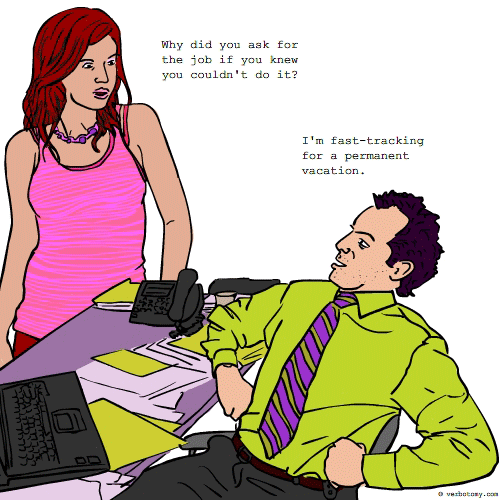
DEFINITION: v. To focus on your weaknesses, rather than your strengths. n. A person who is obsessed with their perceived deficiencies, and works hard to ensure that everyone else understands and appreciates their failings.
Verboticisms
Click on each verboticism to read the sentences created by the Verbotomy writers, and to see your voting options...
You have two votes. Click on the words to read the details, then vote your favorite.
Mignify
Created by: Pyrrhocephalous
Pronunciation: Mig'-nif-ai
Sentence: "Could you wash the dishes for me, dear?" "Sure, Mommy! Hopefully I won't drop any like I did yesterday. Or bend the spoods too hard. Or accidently toss any on Fluffball..." "Actually, Suzie, why don't you go play with your friends? I can wash them" Suzie successfully mignified her way out of doing the dishes.
Etymology: Minimum + Magnify, since a mignifier is magnifying his minimum ability.
Praiserhater
Created by: verbherder
Pronunciation: preyz-er-heyt-er
Sentence: "John, your memo moved me to tears. I never thought unisex restroom liquid soap policy could cleanse my soul as well as my hands," gushed Sally. "Yeah, but I always leave the seat up and use a baker's dozen hand towels before I even get going. It's a big problem for me." "Ugh! You're the biggest praiserhater in the whole office," exclaimed Sally.
Etymology: Don't hate the praise, hate the game.
Wreckedutation
Created by: Mustang
Pronunciation: reckt - you - TAY - shun
Sentence: Warburton had a very flimsy sense of self worth and would often engage in wreckedutation, a form of verbal self abuse and degredation.
Etymology: blend of wrecked and reputation
Faulterego
Created by: mweinmann
Pronunciation: fal - tur - ee - go
Sentence: Stephanie has a strong faulterego. Those who know her well realize that she is an intelligent, capable woman. She is so good at downplaying her strengths in favor of her weaknesses that at times, she seems like another person.
Etymology: fault, falter, alter ego (An alter ego (Latin, "the other I") is a second self, a second personality or persona within a person. It was coined in the early nineteenth century when schizophrenia was first described by early psychologists. A person with an alter ego is said to lead a double life)
----------------------------
COMMENTS:
good one - Nosila, 2009-06-09: 11:08:00
 Got my vote - DrWebsterIII, 2009-06-09: 13:33:00
Very good! - Mustang, 2009-06-09: 18:15:00
----------------------------
Pessimeister

Created by: DrWebsterIII
Pronunciation: Pes - a - misetr
Sentence: Peter was such a pessimeister. He was always pontificating on the possible negative outcome and preached about his problems and flaws.
Etymology: Pessimist (one who focuses on the negative) + Meister (master)
----------------------------
COMMENTS:
hahaha funny...like it. - mweinmann, 2009-06-09: 17:28:00
----------------------------
Incompetitor

Created by: petaj
Pronunciation: in-COM-pet-it-tah
Sentence: Marty's ambition was to be the incompetitor of the month. So he launched into self-demotion at every opportunity until the entire staff was well aware of his every foible.
Etymology: incompetence + competitor
----------------------------
COMMENTS:
on a roll petaj - Jabberwocky, 2008-04-29: 12:19:00
 thanks jabber. I though blooprint was pretty good, but had my doubts this would be popular - petaj, 2008-04-30: 02:59:00
Nice word. - OZZIEBOB, 2008-04-30: 21:33:00
----------------------------
Degretation
Created by: Mustang
Pronunciation: degh-reh-TAY-shun
Sentence: Carletons sense of self worth was flimsy at best, bordering on nonexistent, and he would frequently abase himself in his self styled degretation, using verbal self abuse and humiliation.
Etymology: Blend of degrade and reputation
Derogavocation
Created by: Jabberwocky
Pronunciation: dare/og/ah/voe/cay/shun
Sentence: He made it his life's derogavocation to belittle himself as much as possible and present himself in the least attractive way.
Etymology: derogation + vocation
Wimperfector
Created by: Nosila
Pronunciation: wim per fek tor
Sentence: Wayne was such a wimperfector that when he was absent, his productivity at work went up. His boss wrote on his annual review:"I can assure you that no person would be better for this job. We are very fortunate to get this person to work for us."
Etymology: Wimp (a weak person) & Imperfect(not perfect; defective or inadequate) & Perfector (a person who completes or makes something perfect)
Flawplan
Created by: OZZIEBOB
Pronunciation: FLAW-plan
Sentence: Bob spelt out his career plan with acronymical alacrity. It read: "F" for frustrating and thoughtlessness; "L" for lethargic and litigious; "A" for aimless and antediluvian; "W" for workshy and weaseling; "P" for plastic and procrastinating; "L" for lackadaisical and laconic; "A" for asinine and anal-retentive and "N" for neglectful and nepotistic. He was elected - maybe - for his honesty; or, more likely, by the "donkey" vote!
Etymology: FLAW: fault(s), defects, imperfection(s) & PLAN: to have a specific aim or purpose; a scheme or method of doing something put together in advance.
----------------------------
COMMENTS:
very clever
- petaj, 2008-04-29: 04:58:00
Hmmmmm, is that a thinly veiled political swipe! - pieceof314, 2008-04-29: 09:44:00
love the sentence - Jabberwocky, 2008-04-29: 12:22:00
----------------------------

Comments:
Today's definition is inspired by Johnny Bunko's Career Secret # 2: "Think strengths, not weaknesses". See: "The Adventures of Johnny Bunko" by Dan Pink. Thanks Dan! ~ James
Today's definition is inspired by Johnny Bunko's Career Secret # 2: "Think strengths, not weaknesses". See: "The Adventures of Johnny Bunko" by Dan Pink. Thanks Dan! ~ James
Today's definition was suggested by johnnybunko. Thank you johnnybunko. ~ James