
Vote for the best verboticism.
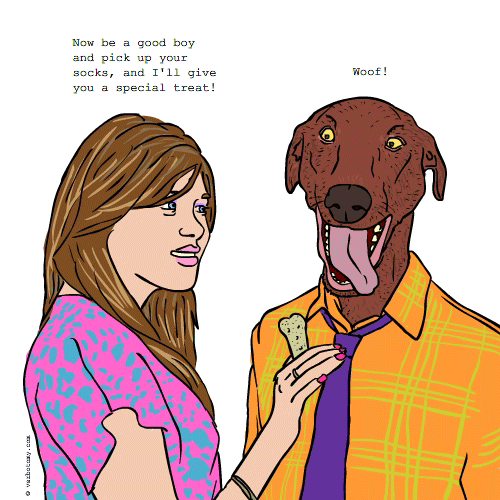
DEFINITION: v. To use animal training techniques to improve and direct the behavior of other people. n. A technique which uses the principles of animal training to solve a human behavioral riddle.
Verboticisms
Click on each verboticism to read the sentences created by the Verbotomy writers, and to see your voting options...
You have two votes. Click on the words to read the details, then vote your favorite.
Barkcoding
Created by: galwaywegian
Pronunciation: bahrk koh ding
Sentence: she was going to train this guy allright. If barkcoding didn't work the rolled up newspaper sure would
Etymology: bark barcoding
Schoolafool
Created by: shija
Pronunciation: school-laf-fool
Sentence: Have you tried schoolafooling?
Etymology: A blend of schooling and fooling.
Homesticate
Created by: Stevenson0
Pronunciation: hoh/mes/ti/kate
Sentence: In most relationships, the woman has to homesticate the male so he can function in modern society.
Etymology: homo sapiens (the modern species of humans) + domesticate (to tame an animal to live with humans); therefore, homesticate (to tame a human to live with humans)
----------------------------
COMMENTS:
good play on the human condition.... - mweinmann, 2009-06-30: 08:02:00
----------------------------
Folklured
Created by: Tigger
Pronunciation: /fohk-loord/
Sentence: Sherry wasn't what you'd call 'book-smart' but she was very good at figuring out what people's motivations were, and which tactics would make them act the way she wanted. She had folklured her boyfriend into a marriage proposal, her parents into buying her another new car, and even her teachers into giving her good grades — now she was about to graduate college, thanks to another student, who was also her enamoured and very lonely tutor. She was definitely going to either work in sales, or in politics.
Etymology: from the word 'Folklore': Folk - people in general, or people of a distinct group (from German, volk "people") + Lured - tempted or enticed into a particular action; used a decoy for fishing or trapping (from Middle Low German, loder "bait")
----------------------------
COMMENTS:
She must have folklured her parents into buying her a new folkswagen! - Nosila, 2008-05-19: 16:56:00
----------------------------
Folkwhisperer
Created by: Nosila
Pronunciation: foke whis per er
Sentence: Abby decided to use her skills as a Horse Whisperer on her human family to see if the methods brought the same great results they had with her equine clients. With a large carrot, she approached her son Marvin cautiously, when he was again tying up her phone for hours. She bent close to his open ear, stroked his adolescent face gently and whispered the calming words which had the desired affect:"Get off that darn phone now or I will jam this carrot into your other ear!" At once he hung up and ran for his room. Yes, using Folkwhisperer methods worked every time... it wasn't tough love, but pavlove!
Etymology: folk (people in general)& the horse whisperer (a person who tames and trains horses by gentle methods and speech)
----------------------------
COMMENTS:
'Pavloved' your story! Too funny! My conditioned response was to LOL... - Tigger, 2008-05-19: 02:49:00
you might not believe it but I didn't read youir sentence before I posted. - stache, 2008-05-19: 13:13:00
I believe you, stache...not the first time great minds have thought alike... - Nosila, 2008-05-19: 16:54:00
----------------------------
Obediencesocool
Created by: splendiction
Pronunciation: rhymes with "obedience school"
Sentence: They had tried everything, it seemed, to eliminate their son’s thumbsucking: behaviour modification, ignoring, even praise. Nothing worked until obediencesocool! The idea of simply complying with their requests actually became the new cool thing to do! They hoped this new trend would last and spawn similar trends.
Etymology: A play on a dog "obedience school".
----------------------------
COMMENTS:
Cool word...what you have to do with teens these days... - Nosila, 2009-06-30: 01:22:00
----------------------------
Henneagram
Created by: galwaywegian
Pronunciation: hen eee aaa gram
Sentence: Her use of the henneagram was richickulous, one fowl idea after another in her so called pursuit of eggselence.
Etymology: enneagram, hen
----------------------------
COMMENTS:
Another eggselent word, no yolks about it. Did you pullet out of the air or is it poultry in motion? - Nosila, 2008-05-19: 17:00:00
----------------------------
Reinforcemen

Created by: mrskellyscl
Pronunciation: re-in-force-men
Sentence: Paula used both positive and negative reinforcemen to get whatever she wanted. Her technique included the rewards of steaks, sports, beer, and the occasional night out with the boys; however, she discovered that sex could be used both positively as a reward and negatively by withdrawing the reward when appropriate.
Etymology: reinforcement: technic whereby the delivery of a stimulus, good or bad, after a response increases the likelihood of the behavior repeating. + men: creatures that have been test subjects for women since the dawn of civilization
Pavlovegantheory
Created by: Jabberwocky
Pronunciation: pav/low/veegan/theory
Sentence: The pavlovegantheory explores conditioning the reflexes of patrons to eat only vegetables when the subjects hear a bell ringing. An example would be the huge success of Potaco Bell.
Etymology: Pavolovian theory (dog's salivating when they hear a bell ringing) + vegan
Treaser
Created by: josje
Pronunciation: treaser
Sentence: i am a perfect treaser
Etymology: trainer en teaser

Comments:
Today's definition is inspired by Amy Sutherland's new book "What Shamu Taught me About Life, Love and Marriage". where she reminds us that "People are animals too!", and that "Any interaction is training". Now Amy has invented her own word for this and it's "Shamu", so I have added it today's list of verboticisms! Thanks Amy! ~ James
Today's definition is inspired by Amy Sutherland's book "What Shamu Taught me About Life, Love and Marriage", where she reminds us that "People are animals too!", and that "Any interaction is training". Of course, Amy has invented her own word for this -- "Shamu". Let's see what we come up with now... Thanks Amy! ~ James
Today's definition was suggested by amysutherland. Thank you amysutherland. ~ James